
(Sharing my final assignment for MS ABA Measurement and Experimental Design. I’m officially enrolled for Functional Behavior Assessment (FBA) the 4/10 ABA master’s level requirements!)
- Literature Review
Sensory processing differences can create significant barriers to workplace participation for autistic adults (Pfeiffer et al., 2019), often making it difficult to maintain on-task behavior in typically noisy office environments. To mitigate these challenges, sensory-based accommodations are frequently recommended; however, a recent systematic review highlights a critical scarcity of empirical evidence to guide the selection of these supports (Zafar et al., 2019). This lack of data leaves both employees and employers without clear, individualized guidance.
Key findings into specific auditory interventions show promise but remain focused on isolated effects. A seminal study by Söderlund et al. (2007) provided foundational evidence for the “moderate brain arousal” model, demonstrating that auditory white noise improved cognitive performance and recall tasks in children with ADHD. The researchers posited that the noise provides optimal arousal levels, aiding neural signaling. Similarly, studies on other sensory interventions, such as deep pressure, show that modulating sensory input can directly affect physiological arousal, supporting the broader principle that sensory tools can regulate states relevant to focus (Reynolds et al., 2015).
Despite these findings, a clear gap persists. No study has directly compared the relative effectiveness of different auditory sensory accommodations, such as auditory masking (e.g., white noise) versus auditory removal (e.g., noise-canceling headphones), for improving on-task behavior in neurodivergent adults. The present study aims to fill this gap by providing comparative data to inform personalized, evidence-based workplace accommodations.
- Proposed Intervention
The proposed intervention is a comparative analysis of two distinct sensory accommodations.
- White Noise Condition: A desktop white noise machine will emit a consistent sound at 65-70 dB to mask ambient noise.
- Active Noise-Canceling (ANC) Headphones Conditions: Participants will wear active noise-canceling headphones with no audio playback, providing auditory isolation.
- A Baseline (no intervention) condition will be included for comparison.
Rationale
This comparison is grounded in the differing theoretical mechanisms of each intervention. White noise functions through auditory masking, providing a steady, predictable stream of sound that may help stabilize the auditory environment and improve cortical arousal for individuals with ADHD (Reynolds et al., 2021). In contrast ANC headphones work via auditory removal, physically reducing the volume of environmental sounds, which may prevent sensory overload for autistic individuals, (Pfeifer et al., 2019). By directly comparing these mechanisms, this study will generate practical, data-driven guidance for selecting individualized workplace accommodations (Zafar et al., 2019), moving beyond anecdotal recommendations.
Implementation
The intervention will be implemented during designated 45-minute focused work blocks. Each morning, a randomized schedule will determine which condition (White Noise, Headphones or Baseline) is in effect for that day’s work block to control for order effects. The researcher will set up the appropriate device (White nose machine or headphones) on the participant’s desk at the start of the session. Data collection will begin once the work period commences.
- Experimental Plan
Experimental Design Choice
An alternating treatment design (ATD), also known as multielement design, will be used. This design is uniquely suited for the rapid and direct comparison for two or more independent interventions (White Noise vs. Headphones) against a baseline condition. Its efficiency allows for a clear demonstration of relative effectiveness within a short timeframe, which is ideal for an applied workplace setting.
Participants
The study will include three neurodivergent adult employees. Selection criteria will include: (1) a formal diagnosis of ASD or ADHD; (2) self-reported significant difficulty with auditory distractions in the workplace; and (3) employment in an open-office environment. A small sample size is appropriate for the single-case experimental design, which prioritizes depth of analysis over generalizability.
Procedure
The procedure will consist of two phases:
- Phase 1: Baseline. For about 3-5 sessions, data on on-task behavior will be collected with no intervention in place to establish a stable pre-intervention level.
- Phase 2: Alternating Treatments. Immediately following baseline, the three conditions (White Noise, Headphones, Baseline) will be alternated in a randomized order across days. This phase will continue for approximately 15 sessions total to ensure adequate exposure to each condition.
Data Collection Method
The dependent variable, on-task behavior, is defined as: eyes oriented toward the computer screen or work-related documents, and hands engaged in typing, writing or mouse navigation. Data will be collected using momentary time sampling procedure. An observer will record whether the participant is on-task at the end of each 2-minute interval throughout the 45-minute session, resulting in a maximum of 22 data points per session. The percentage of on-task intervals per session will be calculated for graphing and analysis.
Data Analysis
The primary method of data analysis will be visual analysis of the graphed data. The data paths for the three conditions will be compared based on:
- Level: The mean percentage of on-task behavior within each condition.
- Trend: The direction and slope of the data path within each condition.
- Variability: The range of fluctuation of the data points around the mean level.
Effectiveness will be determined by a condition producing (a) a higher level of response than the other conditions (b) a stable or accelerating trend with low variability. The Percentage of Non-overlapping Data (PND) will be calculated as a supplementary measure to quantify the effect size of each intervention compared to baseline
Ethical Considerations
Informed consent will be obtained using a document that clearly explains the comparative nature of the study. Participants will be explicitly informed that they may withdraw from any specific conditions at any time without penalty if they find it aversive. All data will be anonymized and stored securely. Furthermore, following the study, participants will be provided with the results and the most effective intervention for their continued use, ensuring the research has direct personal benefit.
5. Hypothetical Graph
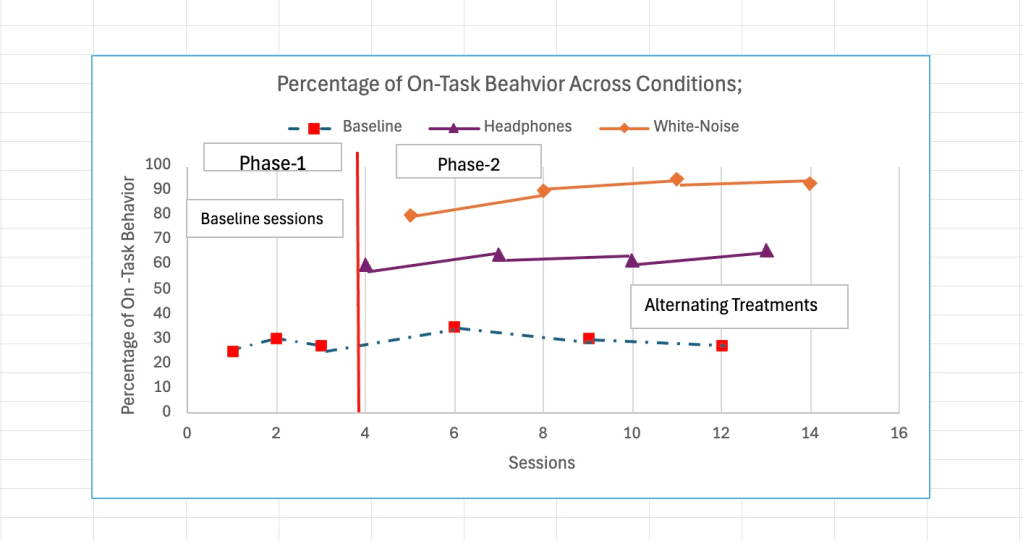
Figure 1
Visual Analysis of Level, Trend, and Variability
Visual analysis of the graphed data reveals a powerful and unambiguous differential effect between three conditions, demonstrating excellent experimental control.
- Level: The mean level of on-task behavior is dramatically and clearly separated across conditions. The White Noise condition demonstrates a very high mean level, approximately 89.8%. The Headphones condition shows a strong intermediate mean level of approximately 63.4%, which is substantially high than the Baseline condition mean of approximately 29.4%
- Trend: The data path for the White Nose condition shows a clear accelerating trend, beginning at 80% and rising to a peak of 95% and 93% indicating improving effectiveness over time. The Headphones condition also demonstrates a slight accelerating trend, consistently increasing from 60% to 66%. In stark contrast, the Baseline condition data are stable with zero-celeration trend, fluctuating randomly within a low range (25-35%) and showing no evidence of improvement.
- Variability: All three conditions exhibit low variability, with data points clustering tightly around their respective mean levels. This stability strengthens the conclusion that the observed differences are a direct result of experimental conditions and not random fluctuations.
The experiment demonstrates a very high degree of experimental control. The participant’s level of on-task behavior is consistently and predictably determined by the specific sensory condition in effect. The massive and sustained change in level from baseline to the intervention conditions, coupled with the distinct and replicable separation between the Headphones and White Noise data paths, provides compelling evidence of a functional relationship.
- Discussion
Analysis of Hypothetical Findings
The hypothetical data presented in Figure 1 offer a clear demonstration of the alternating treatments design’s utility for making individualized, data-based decisions. The results suggest that for the participant in the study, the White Noise condition was the most effective intervention, producing a consistently higher and more stable level of on-task behavior compared to both the Headphones and Baseline conditions. This implies that the mechanism of auditory masking—providing a constant, predictable soundscape—was more beneficial for maintaining focus than the mechanism of auditory removal achieved through headphones. The fact that the Headphones condition still improved performance over Baseline indicates its value as an accommodation, but the differential outcome highlights the importance of comparative assessment.
Implications for Practice and Research
These findings have direct implications for both the field of Organizational Behavior Management (OBM) and practical workplace support. For practitioners, this study proves a methodology for moving beyond a one-size-fits-all approach to sensory accommodations. By using a simple ATD, employers or coaches can efficiently identify the most effective support for an employee, thereby maximizing productivity and job satisfaction. From a research perspective, this study reinforces the need to investigate the mechanisms of action behind common accommodations. Future research should explore whether the superiority of white noise is related to factors like reduced social isolation (compared to headphones) or its specific effect on neurological arousal.
Limitations and Future Research
Several limitations must be acknowledged. First, the use of single-case design with three participants limits the generalizability of the findings to the broader Neurodivergent population. Second, the potential for multiple treatment interference exists, where exposure to one condition may influence performance in another, though randomization helps mitigate this. Third, the study did not measure social validity (participant preference) which is a crucial component for long-term adherence; an employee might find headphones socially stigmatizing even if they are somewhat effective.
Future research should therefore: (1) replicate this study with a larger number of participants to enhance external validity; (2) incorporate social validity measures to assess participant preference and comfort with each intervention; and (3) explore other sensory accommodations (e.g., fidget tools, lighting adjustments) using similar comparative methodologies.
Reflection on the Process
The process of developing this comprehensive measurement plan has been invaluable. It solidified the understanding that a well-defined, observable, and measurable target behavior is the absolute foundation of any successful intervention. Furthermore, selecting the alternating treatments design underscored the principle that the experimental method must be tailored to the specific question being asked—in this case, “Which is better?” rather than “Is this effective?” This exercise highlighted the iterative nature of applied research: defining, measuring, comparing, and analyzing, all while adhering to the highest ethical standards to ensure the participant’s well-being is central to the process.
***Note: I lost points for the varied font used under my references. The reason being—that when I was verifying citations I simply copy pasted “citation” boxes for each of them instead of typing it—each article didn’t use the same font, of course.
References:
1. Kristen Bottema-Beutel, Steven K. Kapp, Jessica Nina Lester, Noah J. Sasson, and Brittany N. Hand. Avoiding Ableist Language: Suggestions for Autism Researchers. Autism in Adulthood 2021 3:1, 18-29
2. Pfeiffer B, Stein Duker L, Murphy A, Shui C. Effectiveness of Noise-Attenuating Headphones on Physiological Responses for Children With Autism Spectrum Disorders. Front Integr Neurosci. 2019 Nov 12;13:65. doi: 10.3389/fnint.2019.00065. PMID: 31798424; PMCID: PMC6863142.
- Reynolds S, Lane SJ, Mullen B. Effects of deep pressure stimulation on physiological arousal. Am J Occup Ther. 2015 May-Jun;69(3):6903350010p1-5. doi: 10.5014/ajot.2015.015560. PMID: 25871605.
- Söderlund G, Sikström S, Smart A. Listen to the noise: noise is beneficial for cognitive performance in ADHD. J Child Psychol Psychiatry. 2007 Aug;48(8):840-7. doi: 10.1111/j.1469-7610.2007.01749.x. PMID: 17683456.
- Zafar N, Rotenberg M, Rudnick A. A systematic review of work accommodations for people with mental disorders. Work. 2019;64(3):461-475. doi: 10.3233/WOR-193008. PMID: 31658080.
 Affectively-Align & Culturally Aware ABA Notebook
Leave a comment